Deutsch
 Français
 Español
 Italiano
 Polski
BLOG » Integrated Metallurgical Finishing for NAK55 and Stainless Steel (March 2026 Release)
Integrated Metallurgical Finishing for NAK55 and Stainless Steel (March 2026 Release)
Bridging the gap between machining and application
The March 2026 release from meviy marks a clear shift from supplying raw machined parts to delivering more integrated, application-ready components. In today’s fast-moving engineering environment, project timelines often slip not because machining takes too long, but because of the secondary finishing work that comes afterwards. By bringing advanced metallurgical treatments directly into the digital procurement workflow, meviy tackles a key friction point that has long led to fragmented and inefficient supply chains.
The core value of this update is the systematic removal of the “finishing bottleneck”. Traditionally, moving from a machined substrate to a functional component meant engineers had to coordinate with specialist plating vendors, which added administrative effort and created schedule risk. This evolution makes it possible to procure finished, high-durability components through a single digital interface, so parts arrive ready for immediate use upon delivery. This integrated approach supports modern engineering programmes where speed to market and metallurgical reliability matter.
NAK55 and specialist stainless steel alloys
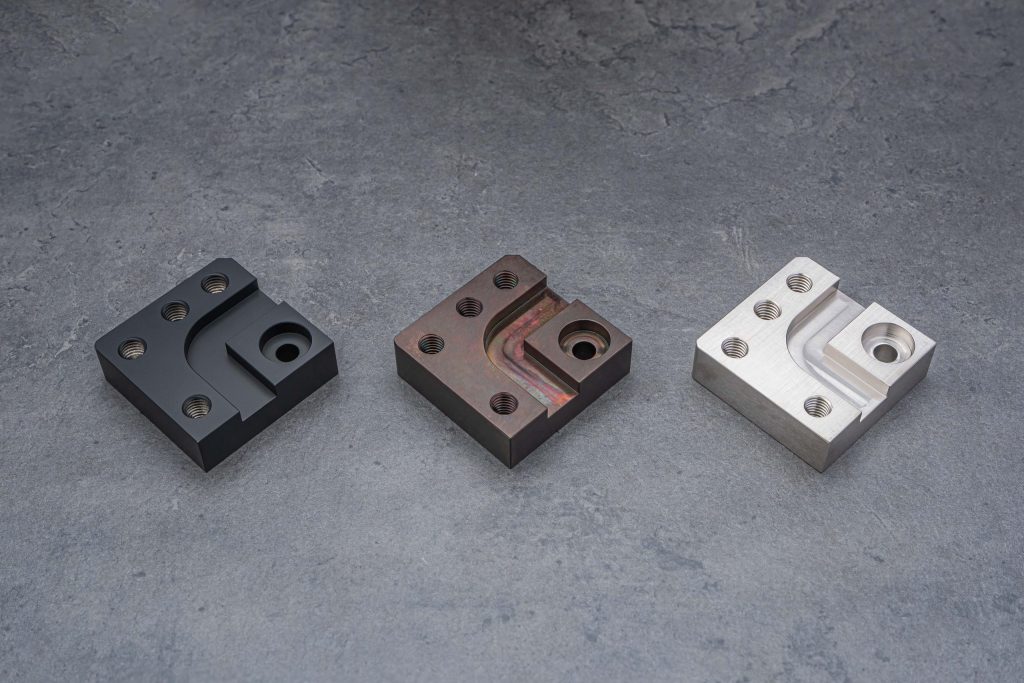
A key part of this release is stronger support for NAK55, the industry standard pre-hardened tool steel. Bringing NAK55 into a full digital finishing workflow is a major capability upgrade, especially for high-precision tooling and large-scale frames.
The release introduces two main material streams:
- NAK55 equivalents: now supported with six high-durability surface treatment options, designed to improve performance in harsh operating conditions.
- Stainless steel alloys: Low Temperature Black Chrome (LTBC) now available across five major alloy groups, including their annealed variants.
Even with strong mechanical properties, both material families have limitations in their raw state. NAK55, for example, oxidises easily, which can create issues during storage and transit on factory floors without climate control.
That is why the six specialised treatment options matter: Black Oxide, Electroless Nickel Plating, Hard Chrome Plating (Flash Plating), Trivalent Chromate (Clear and Black), and LTBC.
Black Oxide and Chromate offer cost-effective passivation and protection during transit.
Hard Chrome (Flash Plating) suits use cases that need extreme surface hardness.
Together, these treatments help protect the material’s performance from environmental damage and surface wear, so the benefits of these alloys carry through into real-world use.
Solving wear and optical interference
Surface treatments change the working properties of a component so it can cope with demanding conditions, especially in robotics and semiconductor environments.
By adding specific electrochemical barriers, engineers can tune a part’s surface to match a precise functional requirement.
| Customer challenges | meviy solution | Technical impact |
|---|---|---|
| Wear Resistance: insufficient durability in high-cycle tool and die manufacturing. | Electroless Nickel Plating | Delivers a hard, uniform surface that significantly extends the service life of NAK55 components under friction. |
| NAK55 Oxidation: high susceptibility to rust, complicating storage and transit. | Black Oxide & Chromate Treatments | Creates a protective chemical barrier, allowing for reliable part storage in non-climate-controlled factory floors without dimensional loss. |
| Optical Interference: unwanted reflections and rust in AI-driven image inspection. | Low Temperature Black Chrome (LTBC) | Provides a deep black finish that minimizes “optical noise” in AI inspection systems while preventing oxidation in sensitive environments. |
Low Temperature Black Chrome (LTBC) plays an important role in optical and semiconductor use cases. It delivers a deep black, non-reflective, corrosion-resistant finish that helps reduce “optical noise” in AI-driven image inspection systems. Its surface stability also matters in semiconductor vacuum chambers, where you need to prevent outgassing and oxidation to avoid process failure. Furthermore, its surface stability is vital in semiconductor vacuum chambers, where preventing outgassing and oxidation is essential to avoid process failure.
Similarly, Electroless Nickel Plating offers a distinct technical advantage through its highly uniform coating thickness. Unlike traditional electroplating, this chemical process ensures a consistent layer across complex geometries. For NAK55 tool components with tight tolerances, this uniformity is indispensable for maintaining a reliable fit in complex assemblies, thereby improving long-term Total Cost of Ownership (TCO).
Eliminating the “finishing bottleneck”
Responding to direct Voice of Customer (VOC) feedback about how vulnerable high-performance alloys can become in global supply chains, meviy has taken aim at the usual friction that comes with managing multiple vendors. By moving towards a “one-stop” digital manufacturing model, you remove the admin of coordinating separate plating suppliers and arranging independent quality audits.
- Lead-time compression: when you combine machining and finishing in one workflow, you avoid shipping parts between vendors. Fewer handovers and fewer logistics steps shorten the overall timeline and improve speed to market.
- Total Cost of Ownership (TCO): you lower TCO by cutting indirect procurement costs. That includes fewer purchase orders, simpler vendor logistics, and less internal QA effort spent auditing third-party platers.
- Quality assurance and reliability: a single digital workflow keeps finishing aligned with the machining specification. That reduces rework risk and gives you a more dependable route to meeting performance requirements, from production through to end use.
Size ranges and delivery tiers
The ability to apply these treatments at scale is critical for industrial applications, particularly for components such as robot base plates and large-scale industrial frames. This release accommodates substantial physical dimensions, ensuring that large-scale infrastructure can benefit from integrated finishing.
| Size Category | Maximum Dimensions (mm) | Available Delivery Tiers |
|---|---|---|
| AQ Range | 400 × 300 × 70 | Standard, Economy, Express |
| MQ Range | 2000 × 1000 × 200 | Standard, Economy, Express |
The inclusion of the MQ range is a vital development for procurement professionals. Supporting dimensions up to 2000 x 1000 mm allows for the sourcing of finished, large-scale robot base plates and frames through a streamlined digital process. This capability ensures that even the largest components in a programme meet the same durability and performance standards as smaller, precision-machined parts.
Semiconductor, robotics, and beyond
This release has been engineered with semiconductor equipment, robotics, and machine tool applications in mind.
These sectors depend on high-value components, where surface wear or unwanted reflection can lead to failure – and you often can’t absorb that risk.
If you need to reduce wear in high-cycle tool and die work, or you need to remove reflections that disrupt AI-based inspection, the integrated treatments give you a practical, evidence-led route forward.
By combining metallurgical know-how with digital procurement, this update helps you move beyond simply producing parts and instead deliver finished, high-performance components that suit real operating conditions.
FAQ
FAQ 1: How do I choose the right surface treatment?
Choose based on what you need to prevent.
- Wear / high-cycle use: Electroless Nickel Plating
- Rust during storage or transit: Black Oxide or Chromate
- Reflections in optical inspection: Low Temperature Black Chrome (LTBC)
FAQ 2: Will surface treatment affect tolerances or fit?
Some treatments add a surface layer, so include finishing in your tolerance plan.
Electroless Nickel Plating applies very evenly, which helps on complex shapes and tight-fit assemblies.
FAQ 3: What’s the benefit of ordering machining + finishing together?
You avoid extra suppliers, extra logistics, and separate QA steps.
That reduces lead-time risk and keeps finishing aligned with the machining specification.