Deutsch
 Français
 Español
 Italiano
 Polski
BLOG » Advanced metal Laser cutting solutions with meviy
Advanced metal Laser cutting solutions with meviy
Achieve outstanding precision, swift turnaround, and dependable quality with our advanced metal laser cutting services. Using state-of-the-art fibre laser systems, we deliver intricate profiles, clean edges, and consistent tolerances across a wide range of metals and thicknesses. Whether you are producing a one-off prototype or scaling to volume, we provide accurate results, transparent lead times, and robust quality assurance tailored to your application. From sheet metal laser cutting for thin components to carbon steel laser cut brackets and panels, our metal laser cutting service is engineered to support demanding specifications with repeatable outcomes. We also accommodate laser cut stainless steel parts and laser cut aluminium components where cosmetic edge quality and tight features are critical.
Why choose meviy for laser cutting solutions?
Our service is built for performance, consistency, and simplicity. We combine industry-leading equipment with experienced technicians and streamlined digital workflows to move you from design to finished parts quickly and confidently. Whether you need a comprehensive metal cutting service covering diverse alloys or a dedicated sheet metal laser cutting job for high-volume production, we provide a clear, predictable path from CAD to parts.
State-of-the-art fibre laser technology with meviy
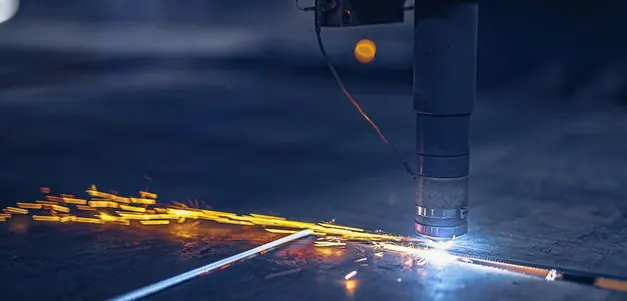
High-power fibre lasers with advanced beam control enable fine kerf widths and minimal heat-affected zones. Depending on material and edge-quality requirements, we use appropriate assist gases—including nitrogen or argon for inert cutting—to prevent oxide formation on the cut edge. This delivers clean, bright surfaces with excellent dimensional stability, particularly for laser cut stainless steel and laser cut aluminium components where cosmetic quality and corrosion resistance matter. The result is crisp internal features, sharp corners, and burr-free edges with reduced need for secondary processing across both ferrous and non-ferrous metals.
Customisable solutions: Cutting strategies are tailored to material, thickness, and geometry. Options include micro-joints for part stability, optimised nesting for cost efficiency, and post-processing such as deburring, brushing, protective films, and surface treatments. For projects involving carbon steel laser cut parts or mixed jobs that include laser cut plastics within assemblies, we advise on assist gas selection, cutting parameters, and process sequencing to maintain dimensional accuracy, edge quality, and consistent results.
Experienced technicians and proven processes: Specialists optimise parameters for each job, from assist gas selection and focal length to feed rates and path strategies. Continuous training and process audits help us meet demanding tolerance requirements while maintaining consistent quality order to order. This discipline underpins our reputation as a reliable metal laser cutting service for complex profiles, fine perforations, and tight slots across sheet metal laser cutting applications.
Metal laser cutting
Laser cutting is most effective when:
– Tight geometry and fine features are required
– Part thickness is within typical sheet ranges
– Cosmetic edge quality matters
Laser cutting becomes less optimal when:
– Very thick plate is involved
– Loose tolerances make punching more economical
– Heat input must be avoided entirely (waterjet preferred)
Benefits of metal laser cutting
Laser cutting combines speed, precision, and versatility in a way that is difficult to match with conventional methods. It is particularly effective for complex geometries, tight tolerances, and materials that benefit from a clean thermal process. Our metal cutting service integrates quoting, manufacturing, and quality checks to streamline delivery.
Precision and accuracy
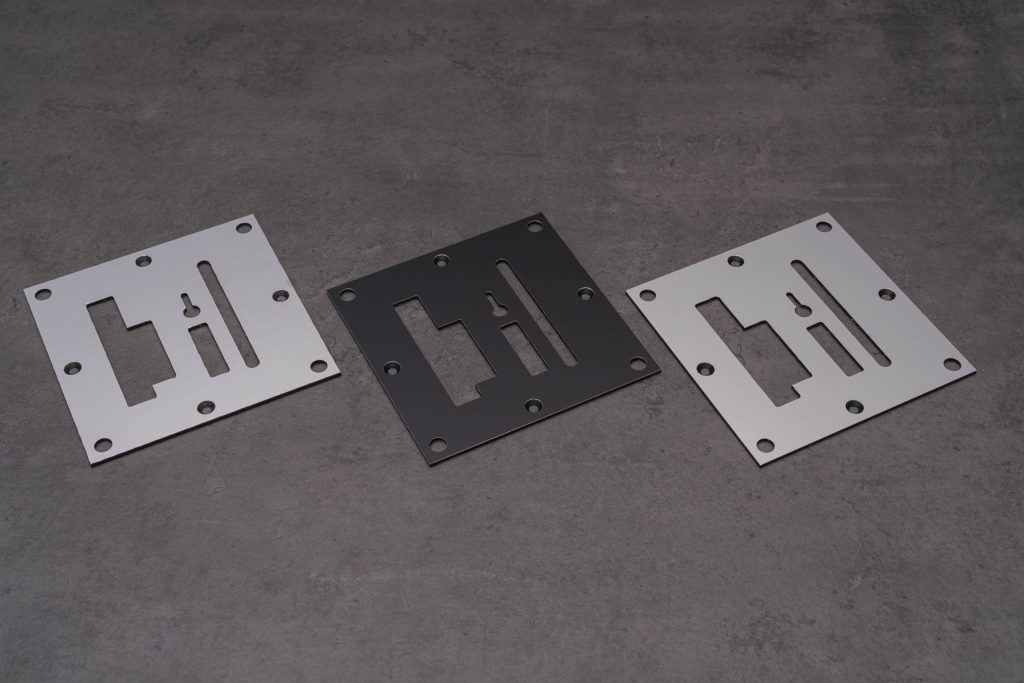
Fibre lasers produce narrow kerfs and excellent edge quality, reducing the need for secondary machining. You can achieve tight internal features, small holes, and repeatable profiles across multiple parts. This applies equally to laser cut stainless steel faceplates, laser cut aluminium brackets, and laser cut steel sheet chassis.
Production efficiency and shorter lead times
High cutting speeds, minimal setup, and rapid nesting reduce cycle times. With digital workflows from CAD to machine, we shorten the path from design approval to finished components, accelerating product timelines. For sheet metal laser cutting in volume, optimised nesting yields material savings and consistent takt times.
Versatility across metals and thicknesses
We process mild steel, stainless steel, aluminium, brass, copper, and specialist alloys. By tuning power, assist gases, and focus parameters, we achieve clean cuts from thin sheet to thicker plate while maintaining consistent tolerances. From carbon steel laser cut structural plates to thin-gauge laser cut plastics used as spacers or covers in multi-material assemblies, we align process settings to your requirements.
Things to Consider with Metal Laser Cutting
Understanding the metal laser cutting process
Our workflow integrates digital design, parameter optimisation, and rigorous inspection to ensure consistent outcomes. The steps below show how parts progress from CAD file to finished components, whether your project involves laser cut aluminium, laser cut stainless steel, or laser cut steel sheet parts within a broader metal laser cutting service.
- Design review: We check CAD data for completeness and manufacturability, verifying layer structures, dimensions, and tolerances.
- Nesting: Parts are arranged on the selected sheet size to minimise scrap and improve yield. This is crucial for sheet metal laser cutting where material utilisation drives cost efficiency.
- Parameter selection: Laser power, focus, and assist gas are chosen based on material and thickness, with pierce settings and lead-ins optimised for quality. Settings differ for carbon steel laser cut plates versus thin laser cut plastics to balance edge condition and speed.
- Cut execution: The machine follows the programmed toolpath, using controlled pierce points, lead-ins, and micro-joints where required to stabilise small features.
- Post-cut handling: Parts are removed, edges are deburred where specified, and surfaces are protected as needed.
- Inspection and dispatch: Dimensional and visual checks are conducted before secure packing and shipment.
- CAD considerations: Accurate CAD files reduce friction and shorten lead times. We accept DXF, DWG, STEP, and IGES. Indicate tolerances, hole sizes, bend allowances (if applicable), and any critical dimensions. Avoid overlapping entities and ensure closed contours to prevent rework and ensure stable cutting. For laser cut aluminium and laser cut stainless steel parts, note any cosmetic requirements so we can adjust assist gases to achieve oxide-free edges.
- Quality assurance: First-article inspections are performed against your specification. We monitor machine calibration, validate edge conditions, and use calibrated instruments for dimensional checks. For repeat orders, process parameters are documented and reused to maintain part-to-part consistency. This approach supports high repeatability in sheet metal laser cutting and across our wider metal cutting service.
Design guidelines for laser-cut metal
Good design practice helps you achieve reliable quality and lower costs. Consider the following when preparing parts for laser cutting. These points apply across laser cut aluminium chassis, laser cut stainless steel faceplates, and laser cut steel sheet brackets produced within our metal laser cutting service.
- Minimum feature sizes: Aim for hole diameters at or above the material thickness. Very small slots or webs should be sized to account for kerf width and material stability.
- Lead-ins and pierce points: Position lead-ins away from critical cosmetic areas. For thick materials, allow for pierce clearance to reduce spatter near important features.
- Bend relief and forming: If parts will be formed, add bend reliefs and locate holes away from bend lines to avoid distortion and cracking.
- Tolerance strategy: Specify essential dimensions selectively. Over-tolerancing can increase cost and lead time; align tolerances with functional requirements.
- Edge finish expectations: Indicate whether oxide-free edges are required. For stainless steel, nitrogen cutting yields clean, cosmetic edges suitable for visible faces. For aluminium, note whether a brushed finish or protective film is preferred.
- Nesting and common-line cutting: Where suitable, use shared edges and tight nesting to improve material yield and reduce cycle time. This is especially impactful in sheet metal laser cutting where high-volume layouts benefit from common-line strategies.
Conclusion
With meviy, advanced metal laser cutting becomes faster, clearer, and more controllable from the very first design step. By combining high-performance fibre laser cutting with an AI-driven digital platform, meviy enables engineers to move directly from CAD data to manufacturable parts—without manual quoting, unnecessary iterations, or uncertainty around lead times. Instant pricing, real-time manufacturability feedback, and consistent process control allow you to optimise designs early while maintaining the edge quality, tolerances, and repeatability required for production-ready components. Whether you are developing prototypes, validating designs, or ordering repeat sheet metal laser cutting parts in volume, meviy delivers a streamlined, data-driven path to precise laser cut stainless steel, aluminium, and carbon steel components—helping you reduce friction, shorten development cycles, and manufacture with confidence.
Frequently Asked Questions
Which metals can meviy laser cut?
meviy supports materials such as stainless steel, titanium, SPCC, and SPHC, using assist gases selected to protect surface quality and material behaviour.
Is laser cutting suitable for production parts or only prototypes?
meviy supports rapid prototyping, functional testing, and low-to-medium volume production where consistency and repeatability matter.
Can laser-cut parts be bent and assembled directly?
Yes. Clean edges and minimal distortion improve bend accuracy and overall assembly quality.
When should I choose laser cutting instead of punching?
Choose laser cutting when you need intricate geometry, tight tolerances, or frequent design changes. It avoids tooling constraints and suits prototypes and small runs where you want speed from CAD to cut part.
What is meviy
meviy is an AI-powered on-demand manufacturing platform from MISUMI. Engineers can upload 3D CAD models to receive instant quotations, manufacturability checks, and lead time estimates. The platform delivers bespoke components to exact specifications across CNC milling, CNC Turning and Sheet Metals. With no minimum order quantity, teams can order from a single part upwards. By streamlining procurement and accelerating product development, meviy enables engineers to bring designs to life faster. Its AI also supports part recognition, interactive design editing, and compatibility with a wide range of materials – making it a smart and reliable tool for modern product development. Backed by MISUMI’s quality standards, customers can expect consistent precision with every order.