Deutsch
 Français
 Español
 Italiano
 Polski
BLOG » Precision where it matters: meviy expands tolerance capability for CNC milled parts
Precision where it matters: meviy expands tolerance capability for CNC milled parts
In practical assembly work, tolerance control often determines whether a design functions as intended. When parts must align, locate, or mount precisely, tolerance limits define whether assembly runs smoothly or requires adjustment and rework.
The latest release from meviy expands machining precision exactly where assemblies require it—while preserving the familiar digital workflow engineers rely on.
This update is a precision upgrade focused on functional performance.
What engineers struggle with
If you work with functional assemblies, you already know the pattern:
- A tolerance of ±0.05 mm is often too loose for parts that must align.
- Even ±0.02 mm can create misalignment, stack-up issues, or inconsistent fits.
- Specifying ±0.01 mm traditionally triggers drawings, emails, and manual quotation requests.
The result is compromise.
Engineers either loosen tolerances to stay within automated processes—or accept slower workflows and fragmented communication to achieve production-level precision.
Neither option supports efficient production.
What this launch changes
This release removes much of that friction.
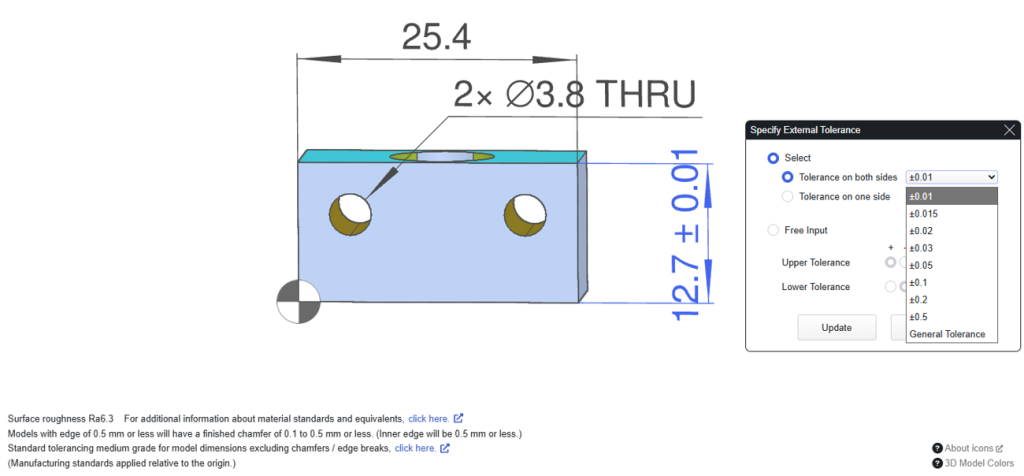
meviy now supports tighter machining tolerances, expanding the achievable range to:
- External dimensions: from ±0.05 to ±0.01
- Hole-to-hole dimensions: from ±0.02 to ±0.01
In practice, this allows engineers to order assembly-critical parts through meviy while specifying tighter tolerances where required.
That means production-level precision, without slowing engineers down.
More than prototypes: supporting functional assemblies
This upgrade reinforces meviy’s position as a platform built not just for fast prototypes, but for functional and assembly-critical components.
With ±0.01 support:
- Mounting interfaces can be designed for consistent alignment.
- Hole patterns can maintain positional accuracy across assemblies.
- Tolerance stack-up can be better controlled at the design stage.
And you don’t have to abandon digital automation to achieve it.
The boundary between automatic and manual quotes remains clear and transparent. Where tighter tolerances are technically feasible, they are supported. Where they are not, the system maintains realistic expectations.
That clarity is essential for engineers working under production deadlines.
Where this matters most
The impact of tighter tolerances becomes obvious in precision-driven industries:
Automotive and E-Mobility
Jigs, fixtures, brackets, and sensor mounts where positional accuracy directly affects performance.
Industrial Machinery
Mounting plates, alignment parts, and interfaces where cumulative tolerance stack-up can disrupt entire systems.
Automation and Robotics
End-effectors, sensor holders, and compact assemblies requiring precise alignment and repeatability.
Electronics and Semiconductor Equipment
Fixtures and mounts for PCBs, optics, and inspection systems where even small deviations matter.
Medical and Laboratory Equipment
Mechanical interfaces demanding consistent, repeatable positioning.
Aerospace and Defence (Non-Flight Parts)
Tooling, test equipment, and ground-support components requiring tight dimensional control.
In all these cases, ±0.01 is not about perfectionism—it is about functionality.
Ready to design with greater precision?
If your assemblies require tighter fits, more reliable alignment, or improved positional accuracy, you no longer need to compromise between speed and precision.
Upload your CAD model and specify ±0.01 where required. Parts transition to manual quote where technically feasible.
The digital workflow remains structured and traceable.
FAQ
Why is ±0.01 handled through manual quote?
Tolerances at ±0.01 require careful evaluation of geometry, material, and manufacturing feasibility. Manual quote ensures that tighter tolerances are applied appropriately and realistically, while still preserving meviy’s digital workflow.
Will selecting ±0.01 cause the system to fail?
No. With this release, specifying ±0.01 no longer disrupts the quoting process. Instead, eligible parts transition smoothly into manual quote evaluation without unnecessary friction.
Are all geometries eligible for ±0.01?
Not automatically. The tighter tolerance range is supported where geometry allows. Factors such as part size, material, feature type, and manufacturing constraints will determine feasibility under manual quote.
Is this suitable for production parts?
Yes. This release specifically supports functional and assembly-critical components, making meviy more suitable for low-to-medium volume production and precision-driven applications.
What is meviy
meviy is an AI-powered on-demand manufacturing platform from MISUMI. Engineers can upload 3D CAD models to receive instant quotations, manufacturability checks, and lead time estimates. The platform delivers bespoke components to exact specifications across CNC milling, CNC Turning and Sheet Metals. With no minimum order quantity, teams can order from a single part upwards. By streamlining procurement and accelerating product development, meviy enables engineers to bring designs to life faster. Its AI also supports part recognition, interactive design editing, and compatibility with a wide range of materials – making it a smart and reliable tool for modern product development. Backed by MISUMI’s quality standards, customers can expect consistent precision with every order.