Deutsch
 Français
 Español
 Italiano
 Polski
BLOG » Welded sheet metal, instantly quoted: what meviy’s new service actually does – and why it matters
Welded sheet metal, instantly quoted: what meviy’s new service actually does – and why it matters
If you have ever tried to source a custom welded enclosure on a tight timeline, you already know the problem.
You finish the CAD model. You send it to three fabricators. Two do not respond. The third comes back four days later with a price that does not include surface treatment, and a delivery date that pushes your project by a fortnight.
This is not an edge case. It is the standard experience for engineers sourcing welded sheet metal across Europe today. The process is fragmented by design – cutting here, welding there, coating somewhere else – and most digital platforms have not solved it. They have simply moved the manual quotation process online.
meviy’s Welded Sheet Metal Service, launching now for the European market, takes a different approach. Here is what it does, what it covers technically, and why several of its design decisions are more significant than they first appear.
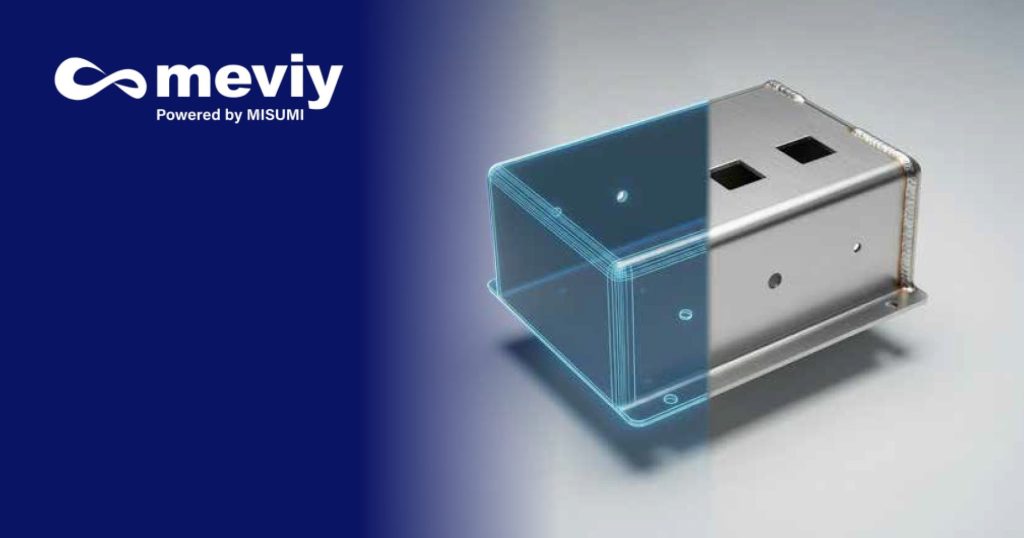
It is the only platform in Europe that provides automatic quotation for welded assemblies – not just for individual sheet metal parts
This distinction matters more than it sounds.
Most digital manufacturing platforms that handle sheet metal will quote a flat part or a bent component automatically. The moment you introduce welding – which requires the system to recognise joint geometry across multiple parts and understand how they connect – the vast majority of platforms revert to manual review. You submit a model, a human reviews it, and you wait.
The competitive research conducted prior to launch assessed sixteen platforms operating in the EU market. The conclusion was direct: no competitor provides a workflow as streamlined as meviy’s for welded assemblies.
meviy’s Automatic Quotation (AQ) system reads your uploaded 3D model and identifies weld connections based on geometry. Specifically, any area where the gap between two component surfaces is 0.15 mm or less is recognised as a weld joint. From that recognition, the system generates pricing and lead time immediately – without involving a person in the quotation loop.
For engineers who already use meviy for CNC parts or flat sheet metal, the experience is consistent. Upload the model. See the price. Place the order.
The service covers steel, stainless steel, and aluminium – with surface treatments included in a single transaction
The materials scope covers structural steel (EN 1.0330 and EN 1.0038 equivalents), stainless steel (EN 1.4301 and EN 1.4016 equivalents), and aluminium (EN AW-5052).
.
That last one is worth noting. Aluminium welding is consistently difficult to source through local fabricators in Europe. Customer research across nine firms found that aluminium welding was frequently unavailable from regional suppliers, or priced at a premium that made it impractical for prototype quantities.
What surprised test users most was the material range within aluminium welding itself. meviy welds aluminium sheet as thin as 1.0 mm — a specification that most regional fabricators will not touch, and that typically requires specialist TIG capability to execute without distortion or burn-through. Sample parts for aluminium assemblies received quality ratings of 4.3–4.4 out of 5 from the engineers who inspected them — the highest scores in the entire test batch.
Surface treatments are ordered in the same workflow, not as a separate transaction. Available options include powder coat and paint across 14 colours, black oxide, electroless nickel plating, trivalent chromate (clear and black), clear and black anodising, and electrolytic zinc plating. This matters specifically because it removes the step where a finished welded part has to be shipped out to a coating supplier before it reaches you.
For a standard structural steel enclosure that needs powder coating, the traditional supply chain requires at minimum two separate orders, two sets of logistics, and two quality checks. With meviy, that is one order, one delivery, and one invoice.

The size range is built around what engineers actually order, not what looks impressive in a spec sheet
The automatic quotation range supports parts where the sum of length, width, and height is up to 1,500 mm, at weights up to 27 kg, with up to three different plate thicknesses per assembly.
For larger or more complex assemblies – up to 1,500 mm combined dimensions, up to five plate thicknesses, or geometries outside the AQ scope – a Manual Quotation (MQ) route is available, handled by the meviy support team.
These limits were not chosen arbitrarily. Research across 27 real customer models found that the dominant demand profile sits between 200 and 500 mm in assembly size. Boxes, covers, enclosures, trays, brackets, connectors, and small auxiliary frames – the components that appear in virtually every custom machine and automation system in European manufacturing.
Large welded frames exist in customer portfolios, but they are low-volume and project-specific. The AQ range is sized to cover the repeatable, day-to-day demand: the three to six welded parts per project that most engineering teams need quickly, in quantities of one to ten, and do not want to spend a week sourcing.
The weld recognition logic is straightforward – but it requires your model to be built accordingly
This is the part that most determines whether your first upload results in an instant quote or a failed recognition.
The system identifies weld connections by reading proximity between surfaces. If two component faces are 0.15 mm or less apart, the system treats them as joined. If the gap is larger – even marginally – the weld connection goes unrecognised, and the assembly may not receive an automatic quote.
When 27 customer-provided models were tested against the AQ system, only 26 per cent passed on the first attempt. Of the failures, 70 per cent were outside the service range entirely. But 20 per cent failed specifically because the system could not identify any weld locations in the model – despite the geometry being within the supported scope.
When those models were adjusted to bring component gaps within the 0.15 mm threshold, the addressable rate rose significantly.
A telling detail from the testing: 10 % of the overall AQ success rate came specifically from models that customers adjusted after receiving guidance on meviy’s requirements — not from models that worked first time. That figure makes the case for clear design documentation more concisely than any argument could.The practical implication: if you design your welded assembly with the 0.15 mm rule in mind from the start, the quotation process works as described. If you upload a model designed for a different fabrication process without adjustment, it may not. The platform provides a 3D viewer that shows recognised weld locations before you confirm the order – use it to verify the assembly reads correctly before proceeding.
For quantities of one to four parts, meviy’s pricing is specifically structured to be competitive where most fabricators are weakest
meviy’s pricing strategy has been built around the 1–5 part range as the core competitive band. This is not a minor detail. The research found that the majority of European customers in this segment order one to ten parts per design, with annual demand of perhaps fifty parts total per customer. They are not ordering in volume. They need competitive pricing at low quantities, with the administrative overhead removed.
What the service looks like in practice
The order flow is consistent with other meviy services.
Upload your 3D CAD model via the platform. The system reads the geometry, identifies weld connections across your assembly, and generates a price with lead time. You review the weld locations in the 3D viewer before confirming. Select your surface treatment, choose your delivery tier, and add to basket.
For assemblies that fall outside the AQ range, the manual quotation route accepts the same uploaded model and returns a reviewed quote from the meviy support team.
Visual and dimensional inspection takes place at each production stage and during final dispatch. Material certifications and dimensional inspection reports are available on request.
The service is available now. View specifications and upload your first model at meviy-eu.com/welding/.