Deutsch
 Français
 Español
 Italiano
 Polski
BLOG » CNC Machining Cost Drivers: What Really Increases the Cost of CNC Parts?
CNC Machining Cost Drivers: What Really Increases the Cost of CNC Parts?
You upload a 3D model, a price comes back, and the obvious question is: why that number? Change a wall thickness, swap a material, tighten one tolerance, and the figure moves — sometimes a little, sometimes a lot. None of it is arbitrary. CNC cost follows a small, predictable set of drivers, and once you can see them, cost stops being something that happens to your design and becomes something you steer.
This guide breaks down what actually moves the number on a CNC quote — material, geometry, tolerances, finishing, quantity and lead time — and, just as importantly, what you can do at the design stage to bring it down without compromising the part. Where this guide is about cost, our Design for Manufacturability guide covers the underlying geometry rules in more depth; the two are companions, and we’ll point across to it where the topics meet.
1. How a CNC quote is actually calculated
Before the individual drivers, it helps to hold the whole equation in your head, because every driver below is just one term in it. A CNC quote is, in essence:
raw material + (machine time × shop rate) + setup + secondary operations + inspection — all divided across the quantity you order.
Of these terms, machine time is usually the largest and the most variable, and that single fact explains almost everything else. Most “expensive” features are expensive because they take longer to cut, not because of some hidden line-item surcharge. Tighter tolerances, finer finishes, deep pockets, hard materials — they all ultimately cash out as more minutes on the machine: more passes, slower feeds, more careful setup, or more time spent measuring.
Material is a genuine cost in its own right, particularly for premium alloys and engineering plastics, but for the majority of parts the time required to remove and finish that material outweighs the cost of the stock itself. Setup — fixturing the blank, establishing the datum, loading and proving the program — is a fixed cost incurred once per batch, which is precisely why quantity has such a large effect on unit price. Inspection scales with how tightly the part is specified.
Keep this equation in mind and the rest of the article reads as common sense rather than a list of surcharges. And with meviy it isn’t theoretical: because the instant quote recalculates as you change the model, you can watch in real time which edits move the number and which leave it untouched.
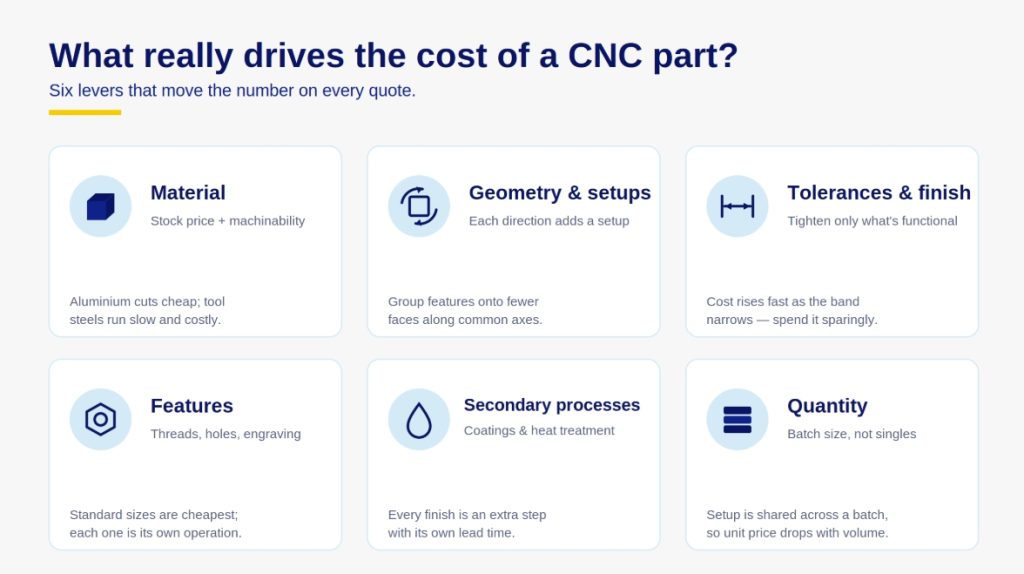
2. Material: stock price and machinability
Two costs hide inside one decision. The first is obvious — what the raw stock costs per kilo. The second is quieter but often larger: how hard the material is to cut. A cheap bar that wears tools, demands slow feeds and needs frequent chip clearing can end up costing more to machine than a pricier alloy that cuts cleanly and quickly. When you choose a material, you’re choosing both numbers at once.
Aluminium is the reference point for affordable machining. EN AW-6061 cuts fast, clears chips well and finishes cleanly — it’s the sensible default whenever cost matters and the application allows it. EN AW-5052 and EN AW-5083 behave similarly. EN AW-7075 is considerably stronger but harder and gummier to cut, so it costs more in both stock and machine time; reach for it when the strength is genuinely needed, not by habit. Free-machining brass, EN CW614N, is among the fastest of all materials to cut and finishes beautifully, though the stock itself isn’t cheap.
Steels cover the widest range. Mild steel (EN 1.0038) machines readily and economically. Stainless steels such as EN 1.4301 and EN 1.4404 work-harden as you cut them — machine too gently and the surface glazes and resists the tool — so they run slower and wear tooling faster, which lifts cost above mild steel for the same geometry. The expensive end is the tool and pre-hardened steels: EN 1.2379, EN 1.2344, DC53 and NAK55 are hard, slow to cut and demanding on tooling, and parts machined from them carry a real and unavoidable premium.
Plastics are not automatically the cheap option. POM (Acetal) and PVC machine easily and economically and are a genuine saving where their properties suit the job. But engineering plastics such as PEEK, PPS and PTFE carry high stock costs and can need careful, slower handling, so specifying “a plastic part” is no guarantee of a lower price.
| Material family | Relative machinability | Relative stock cost | meviy examples |
|---|---|---|---|
| Aluminium | Excellent | Low–medium | EN AW-6061, EN AW-5052, EN AW-7075 |
| Free-machining brass | Excellent | Medium | EN CW614N |
| Mild steel | Good | Low | EN 1.0038 |
| Stainless steel | Moderate | Medium | EN 1.4301, EN 1.4404 |
| Tool / pre-hardened steel | Difficult | High | EN 1.2379, DC53, NAK55 |
| Standard plastics | Excellent | Low | POM (Acetal), PVC, ABS |
| Engineering plastics | Good | High | PEEK, PPS, PTFE |
The takeaway is simple: specify the cheapest material that genuinely meets the requirement, and where strength allows, default toward aluminium or a free-machining grade rather than reaching for a premium alloy out of caution.
3. Material removal and the stock-to-part ratio
A CNC part begins as a solid block or bar and becomes your geometry through subtraction — everything that isn’t the part is cut away as chips. The more material you remove, the more you pay, and you pay twice. You pay for the stock you bought and then turned into swarf, and you pay for the machine time it took to remove it. As a result, a small, intricate part carved out of a large block can be surprisingly expensive relative to its finished size.
The lever here is the stock-to-part ratio: how close the starting blank already is to the final shape. A design that sits near standard stock dimensions, avoids hollowing out large volumes of solid material, and doesn’t demand a blank much larger than its finished envelope will always machine more cheaply than one that requires extensive excavation.
Where a part is essentially a profile cut from plate, meviy’s flat-bar stock options — available across several aluminium and steel grades — start far closer to net shape than a solid billet would, cutting both material waste and cutting time at once. Before committing to a deep cavity or a chunky solid section, it’s worth asking a simple question: is this bulk doing structural work, or has it simply been inherited from the size of the blank? Removing material that serves no function is paying twice for nothing.
4. Geometric complexity and the number of setups
Geometry drives cost through one mechanism above all others: the number of setups. A three-axis machine can only cut what it can reach from a single orientation. Every face that needs machining from a different direction means stopping the machine, re-fixturing the part, re-establishing the datum, and frequently loading a new program. That handling is real work, and it is paid for on every part in the batch — not once.
Designs that keep their features within the manufacturing directions quote automatically and can be machined without bottlenecks. Features that demand machining from many orientations, or that can only be reached with specialist fixturing or genuine multi-axis work, push a part toward manual quotation and a higher price.
The most effective design response is feature consolidation. Wherever the function allows, group features onto fewer faces and orient them along common axes. A part whose holes, pockets and steps are all accessible from the top and one side is markedly cheaper than the same part with features scattered across all six faces and set at compound angles. The geometry hasn’t changed — but the number of times the part has to be handled has, and that is what you’re paying for.
Turning has its own version of the same principle. Simple cylindrical profiles turn quickly and economically. Complex outer and inner profiles, multiple groove types — V-grooves, tapered grooves, radius grooves and negative grooves — keyways, and features that require secondary wire-cutting all add operations and therefore cost. Keeping turned geometry to what a lathe can produce in a single chucking is the turning equivalent of minimising setups on a mill.
5. Tolerances and surface finish
Of everything engineers tend to over-specify, tolerance is the most expensive. A general tolerance is achieved by the machine simply doing its job. A tight tolerance demands slower, more careful cutting, additional passes, more frequent measurement, and occasionally rework when a feature drifts out of band. Critically, the relationship is non-linear: halving a tolerance can more than double the effort required to hit it reliably, because you move from “the machine just does it” into the territory of compensating for tool wear, thermal movement and material spring-back.
meviy applies sensible general tolerances by default — JIS B 0405 medium (m) for length dimensions, with geometric tolerances such as flatness, perpendicularity and parallelism held to standard grades — and can hold tighter wherever it’s genuinely needed, down to ±0.01 mm and tolerance grade IT6 or finer. The cost discipline that follows is straightforward: apply tight tolerances only to the surfaces that actually mate, locate or seal, and leave everything else general. A drawing that calls out ±0.01 mm across every dimension is paying for precision the part will never use.
Surface finish obeys the same logic. A standard machined finish, around Ra 6.3, comes straight off the tool at no extra cost. Finer finishes — Ra 1.6, Ra 0.8, down to Ra 0.4 — require additional finishing passes at slower speeds, and each step toward smoothness adds time. meviy offers Ra 0.4 to Ra 6.3 for milled parts and Ra 1.6 to Ra 6.3 for turned parts. As with tolerances, the rule is to specify a fine finish only where function or sealing demands it. A cosmetic-grade finish applied to every surface as a default is a quiet, recurring cost that adds nothing the part needs.
| Specification | Cost impact | When to use |
|---|---|---|
| General tolerance (JIS B 0405 m) | Baseline | The majority of dimensions |
| Tight tolerance (±0.01 mm, IT6+) | High, rises non-linearly | Mating, locating and sealing surfaces only |
| Standard finish (≈ Ra 6.3) | Baseline | Non-functional surfaces |
| Fine finish (Ra 0.4–1.6) | Adds finishing passes | Seals, sliding fits, true cosmetic faces |
6. Internal radii, deep pockets and thin walls
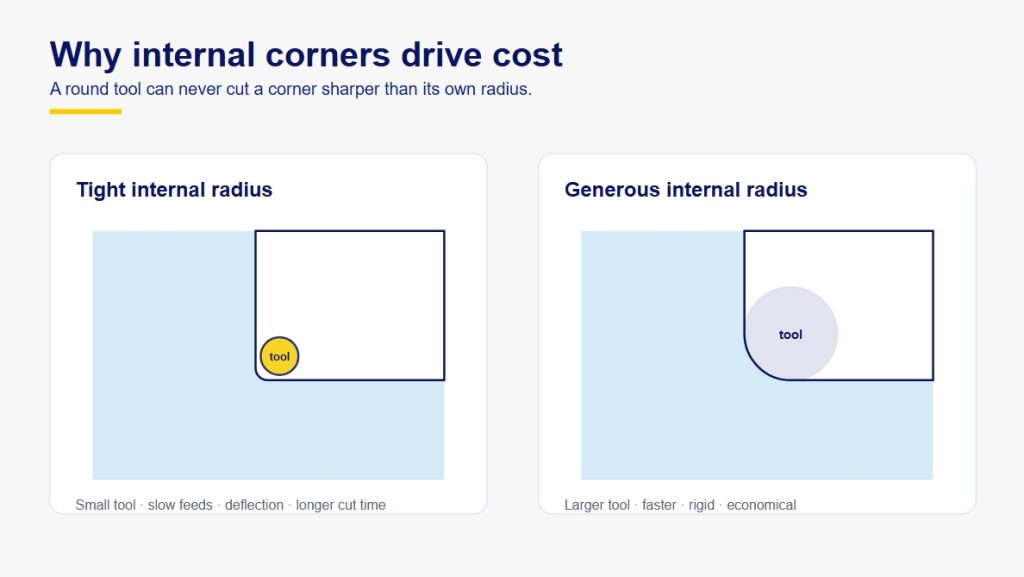
Some of the most expensive features look entirely innocent on a drawing. The clearest example is the internal corner. A CNC cutting tool is round, so an internal corner can never be sharper than the radius of the smallest tool used to cut it. Specify a tiny internal radius and you force the shop to use a small-diameter tool — which cuts slowly, deflects under load, wears quickly and is prone to chatter. Specify a generous internal radius and a larger, faster, more rigid tool does the same work in a fraction of the time. It is one of the cheapest savings available, and in most designs it costs nothing in function. Where a model does call for very small internal corners, meviy finishes corners of 0.5 mm or less with a small C0.1–0.5 mm rather than forcing an impractically tiny tool.
Deep pockets are the second trap. As a pocket grows deeper relative to its width, the tool needs more reach, becomes more prone to deflection, and must cut more conservatively to avoid chatter and breakage. Keeping pocket depth within a few multiples of the tool diameter keeps the cut fast and reliable; pushing well beyond that turns a quick operation into a slow, careful one.
Thin walls are the third. They vibrate under cutting forces, and that vibration forces gentle, slow passes and raises the risk of producing scrap. Adding a modest amount of wall thickness, or introducing a supporting rib, frequently costs less in machine time than the slow, cautious machining a fragile wall demands — and it removes the scrap risk entirely. In each of these cases the lesson is the same: a feature that’s hard for the tool to reach or hold steady is a feature that’s expensive to cut.
7. Threaded holes, hole count and engraving
Threaded holes are routine, but they aren’t free — each one is a separate operation. meviy supports threads from M2 to M36, in UNC and UNF, along with conical threads and threaded inserts. Standard sizes at standard depths are the cheapest; unusually fine, deep or non-standard threads cost more to produce. Threaded inserts add a component and a step, but they earn their cost back in assemblies that will be repeatedly disassembled, where they far outlast threads cut directly into a soft material.
Hole count and variety matter in the same way. A handful of common-diameter holes is quick work; dozens of holes across many sizes, and particularly holes set at compound angles, add up to real machine time. Engraving is a useful traceability feature — meviy supports alphanumeric characters and some symbols from 3 to 30 mm, including part numbers — but it is another pass on the machine, so it’s worth reserving for where it genuinely adds value rather than applying it as a default.
One point specific to turning: thread shapes are not recognised automatically from the 3D model and are set up separately. Threads on turned parts therefore need to be specified explicitly rather than assumed from the modelled geometry.
8. Surface treatments, heat treatment and other secondary processes
Everything that happens after the part leaves the machine is a secondary cost — an additional process step, frequently outsourced, and almost always carrying its own lead time. These processes are legitimate and often essential, but the key word is chosen: each one should be specified because the part needs it, not added out of habit.
Surface treatments address corrosion protection, wear resistance and appearance. meviy’s milling menu includes black oxide, electroless nickel, hard chrome, trivalent chromate, chromate in clear and black, phosphating and nitriding; aluminium adds anodising in clear, black, matt black, red and gold, as well as hard anodising. Each treatment adds cost and time, and some add considerably more than others — hard chrome and hard anodising sit well above a light chromate. The discipline is to choose the lightest treatment that meets the corrosion and wear requirement, not the most protective one available.
Heat treatment is the heaviest secondary process of all. Through-hardening and vacuum hardening to between 30 and 63 HRC strengthen a part substantially, but they add steps, add lead time, and introduce distortion risk — and parts often need machining both before and after hardening to reach final tolerances, effectively splitting the job in two. Where a hard surface is required but full bulk hardening is not, a pre-hardened material such as NAK55 can deliver the hardness without a separate heat-treat cycle, saving both cost and schedule. It’s a substitution worth considering early, before the design commits to a soft material plus a hardening step.
| Process | Typical purpose | Cost / lead-time impact |
|---|---|---|
| Anodising (aluminium) | Corrosion resistance, appearance | Low–medium |
| Black oxide / chromate | Light corrosion protection | Low |
| Electroless nickel | Uniform corrosion and wear resistance | Medium |
| Hard chrome / hard anodising | Heavy wear resistance | High |
| Nitriding / phosphating | Surface hardness | Medium |
| Heat treatment (30–63 HRC) | Bulk strength and hardness | High (extra steps, distortion control) |
9. Quantity and batch size
Setup is a fixed cost paid once per batch, whether you make one part or fifty. Spread across a single piece, that setup is effectively the whole story; spread across a batch, it shrinks toward insignificance per part. This is why unit price falls as quantity rises, and why a one-off prototype can look expensive on a per-part basis — you are carrying the full setup cost on a single piece.
The practical implications are worth being explicit about. Prototype quantities carry a setup premium that is entirely normal and unavoidable; it is not a sign of a bad quote. Ordering a small batch rather than singles can cut the unit cost dramatically, often more than people expect, because the setup is suddenly shared. And consolidating several design revisions, or several related parts, into a single order shares setup and handling across all of them.
meviy’s instant quote makes these price breaks directly visible. Adjust the quantity and the unit price steps down in front of you, so you can find the point at which adding a few more parts barely changes the total cost — frequently the most economical quantity to order is slightly higher than the number you first had in mind.
10. A pre-quote cost-reduction checklist
Most parts arrive at the quote stage with two or three cost levers still sitting unused. Pulling them costs nothing at the design stage and compounds across a production run. Before you request a quote, run the part through these questions:
- Material — Is this the cheapest material that genuinely meets the requirement? Could aluminium or a free-machining grade replace a harder alloy chosen out of caution?
- Material removal — Does the part start close to standard stock, or is it carved from a much larger block? Could flat bar reduce the waste?
- Setups — Are features grouped onto as few faces as possible, along common axes? Are there compound angles that could be avoided?
- Tolerances — Is every tight tolerance on a surface that actually mates, locates or seals? Can the rest stay general?
- Surface finish — Is a fine finish specified only where it’s functional, rather than everywhere by default?
- Internal radii — Are internal corners as generous as the design allows?
- Pockets and walls — Are pockets shallow relative to their width, and walls thick enough to machine without chatter?
- Features — Are threads standard sizes at standard depths? Is the hole count and variety reasonable? Is engraving actually needed?
- Secondary processes — Is each surface treatment, and any heat treatment, genuinely required? Could a pre-hardened material avoid a heat-treat cycle altogether?
- Quantity — Would a small batch cut the unit cost meaningfully compared with ordering singles?
None of these compromises the part. Each simply spends precision, material and time where they matter and relaxes them where they don’t.
12. How meviy makes cost drivers visible
The reason cost so often feels like a black box is that, in a traditional workflow, you only see the number after the design is locked and the request has gone out — far too late to act on it. meviy inverts that sequence.
Upload your 3D CAD model and you receive an instant quote. Because that quote recalculates as you change the part, the cost drivers become visible while you can still do something about them. Tighten a tolerance, swap a material, deepen a pocket, increase the quantity — and you see the consequence immediately, not three days later in an email. The platform’s Design for Manufacturability feedback flags features that drive cost or manufacturing risk before they ever reach the shop floor. And because meviy covers CNC milling, CNC turning and sheet metal on a single platform, parts that would otherwise be sourced and managed separately can be consolidated, sharing the overhead of supplier management. Cost stops being a verdict delivered at the end of the process and becomes a variable you tune as you design.
Frequently asked questions
What’s the single biggest cost driver in CNC machining?
Machine time. Most of the other drivers — tight tolerances, fine finishes, hard materials, deep pockets — are expensive precisely because they add time on the machine.
Does material or machining cost more?
It depends on the part, but for most parts the time required to machine and finish the material outweighs the cost of the raw stock. Hard-to-cut materials raise both at once.
How much do tight tolerances add to the cost?
Tolerance cost rises non-linearly: tightening a band can more than double the effort needed to hit it reliably. The fix is to apply tight tolerances only to functional surfaces and leave the rest general.
Is it cheaper to order in bulk?
Yes. Setup is a fixed cost per batch, so unit price falls as quantity rises. Single parts carry the full setup cost on one piece.
How can I reduce my CNC machining cost?
Choose the cheapest adequate material, consolidate features onto fewer faces, relax non-functional tolerances and finishes, use generous internal radii, avoid deep pockets and thin walls, order in batches, and plan for standard lead times.
Conclusion
Cost on a CNC quote is neither a mystery nor a fixed verdict. It’s the sum of a handful of drivers — material, removal volume, the number of setups, tolerances, finishes, features, secondary processes, quantity and lead time — and every one of them is shaped by decisions made at the design stage. The engineers who consistently get the best prices aren’t negotiating harder; they’re designing with the drivers in mind, spending precision and material where the part needs it and relaxing them everywhere else.
The fastest way to see this in practice is to put a real part through it. Upload your 3D CAD model to meviy, watch the instant quote respond as you adjust the design, and use the feedback to bring the cost down before a single chip is cut.