Deutsch
 Français
 Español
 Italiano
 Polski
BLOG » Precision Control for Holes: Flat Bottom and Depth Tolerance Upgrade in meviy
Precision Control for Holes: Flat Bottom and Depth Tolerance Upgrade in meviy
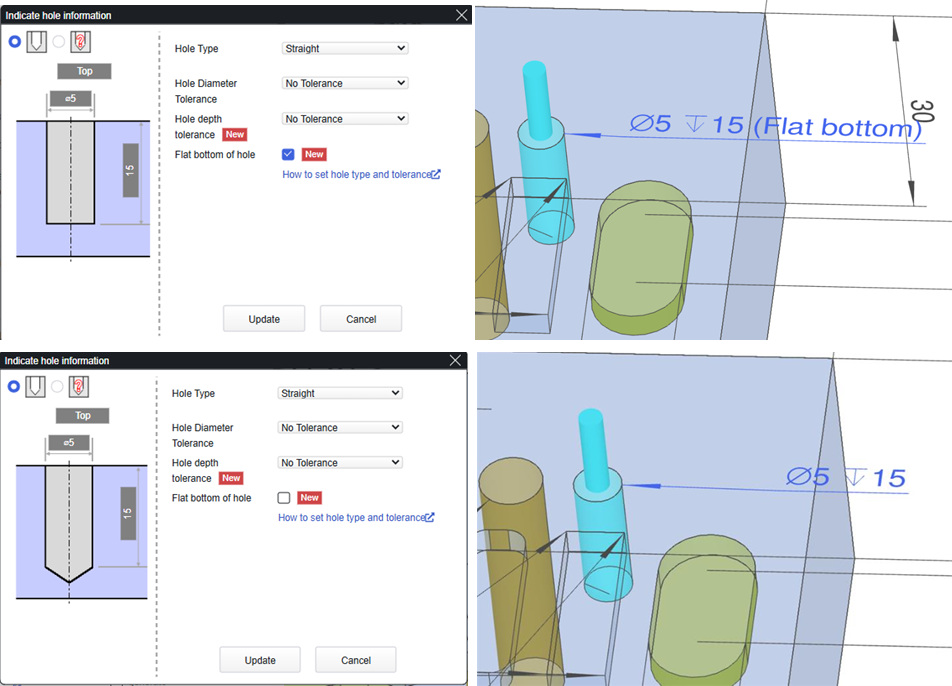
On 14 December, meviy rolls out two highly requested enhancements to its CNC machining service: flat bottom hole specification and explicit hole depth tolerances.
Together, these updates give you far greater control over blind holes, one of the most failure-prone features in machined parts.
If you have ever opened a box of parts and discovered a conical hole bottom where your CAD clearly showed a flat surface, you already know why this matters.
These changes bring manufactured parts closer to design intent, reduce ambiguity during inspection, and support more reliable assemblies across automotive, robotics, hydraulics, and general machinery.
What engineers struggle with
Engineers designing CNC-milled parts have long faced uncertainty and repetitive manual tasks when specifying blind holes:
- Random bottom shape: CAD models show a flat bottom, but parts often come conical by default.
- No depth tolerance: Critical for assemblies, hydraulics, and sensors, depth was previously uncontrolled.
- Time-consuming corrections: Manual quotation requests or additional notes slowed down iterations.
This resulted in reduced productivity, inconsistent assembly performance, and repeated back-and-forth with manufacturers.
What this launch changes
The new controls streamline hole specification and tolerance management:
- Engineers can select a flat bottom for blind holes directly in the platform.
- Depth tolerances (Automatic quotes: ≥0.1 mm, Manual quotes: 0.04–<0.1 mm) are fully supported and visible in both the 3D viewer and 2D drawings.
- Less dependence on manual quoting, with a greater number of cases now handled automatically.
- Predictable part quality with fewer discrepancies between the CAD model and the final component.
Result: faster, more accurate, and controlled hole specifications without extra steps or special requests.
Specification overview
Table 1: Supported hole types and diameter ranges
| Hole Type | Configurable | Diameter for Automatic quotes | Diameter for Manual quotes | Unavailable Diameter |
|---|---|---|---|---|
| Straight | Yes | Ø4 mm or greater | Ø1–<Ø4 mm | <Ø1 mm |
| Slot | Yes | Ø4 mm or greater | Ø1–<Ø4 mm | <Ø1 mm |
| Precision | Yes | Ø4 mm or greater | Ø1–<Ø4 mm | <Ø1 mm |
| Tap, Insert, Countersunk, Pilot | No | – | – | – |
Table 2: Tolerance ranges
| Hole Type | Tolerance Location | Automatic quotes | Manual quotes | Unavailable |
|---|---|---|---|---|
| Straight | Hole depth | ≥0.1 mm | 0.04–<0.1 mm | <0.04 mm |
| Slot | Hole depth | ≥0.1 mm | 0.04–<0.1 mm | <0.04 mm |
| Precision | Effective depth | ≥0.1 mm | 0.04–<0.1 mm | <0.04 mm |
Table 3: Surface treatment restrictions
| Surface Treatment | Automatic quotes | Manual quotes | Notes |
|---|---|---|---|
| Trivalent Chromate | ≥0.2 mm | <0.2 mm | – |
| Hard Anodise & Nitriding | Not available | – | – |
| Hardening | ≥0.2 mm | ≤0.08 mm | Only for selected steels |
Applications of flat bottom holes and depth tolerances
Flat bottom holes and depth tolerances are crucial in:
Automotive: seating surfaces for sensors, alignment of hydraulic or cooling systems.
Robotics & Automation: precise mounting points for actuators, clamps, and pins.
Hydraulics & Pneumatics: O-ring grooves and sealing surfaces with consistent depth.
Machinery: load-bearing or assembly-critical interfaces requiring repeatable depth and flatness.
Conclusion
This release strengthens meviy’s position as a precision-first, engineer-centric platform. By adding flat bottom hole specification and depth tolerance controls, engineers can now design with confidence, knowing the finished part matches the CAD intent. The upgrades eliminate uncertainty, reduce dependence on manual quoting, and support functional reliability across industries, from automotive and robotics to hydraulics and high-tech machinery.
With these updates, meviy offers engineers greater control and reliability, delivering automated precision from the first prototype all the way to full production.
What is meviy
meviy is an AI-powered on-demand manufacturing platform from MISUMI. Engineers can upload 3D CAD models to receive instant quotations, manufacturability checks, and lead time estimates. The platform delivers bespoke components to exact specifications across CNC milling, CNC Turning and Sheet Metals. With no minimum order quantity, teams can order from a single part upwards. By streamlining procurement and accelerating product development, meviy enables engineers to bring designs to life faster. Its AI also supports part recognition, interactive design editing, and compatibility with a wide range of materials – making it a smart and reliable tool for modern product development. Backed by MISUMI’s quality standards, customers can expect consistent precision with every order.
FAQ
Q1: What is the flat bottom hole feature in meviy?
A1: Engineers can now select a flat bottom for compatible blind holes. This ensures the manufactured part matches CAD intent, providing a stable seating surface for pins, valves, or sensors.
Q2: Which holes support depth tolerance?
A2: Engineers can now specify depth tolerances for straight, slot, and precision holes: automatic quotes support tolerances ≥0.1 mm, while manual quotes allow 0.04–<0.1 mm. Depth tolerances are not available for tap, insert, countersunk, or pilot holes.
Q3: Does using these features affect lead time?
A3: No. Lead times remain unchanged across Rapid, Expedite, Standard, or Long delivery options. Tolerances do add an inspection cost, but the delivery schedule is unaffected.
Q4: Are these features available for all materials and surface treatments?
A4: Some restrictions apply. For example, hard anodising, nitriding, and certain treatments have minimum thickness requirements. Details are reflected automatically in meviy’s interface.
Q5: How does this update improve design reliability?
A5: By specifying bottom shape and depth, engineers reduce functional variation, improve sealing, strengthen load-bearing features, and minimise inspection discrepancies.
Q6: Can these updates be used from prototype to production?
A6: Yes. Flat bottom and depth tolerance options are fully supported across single prototypes, small batches, and full production runs, maintaining consistency from early design to final assembly.