- HELP
- Technical Information
- Welded Sheet Metal
- Accuracy and Specifications
- About Edge Breaking (Welded Sheet Metal parts)
About Edge Breaking (Welded Sheet Metal parts)
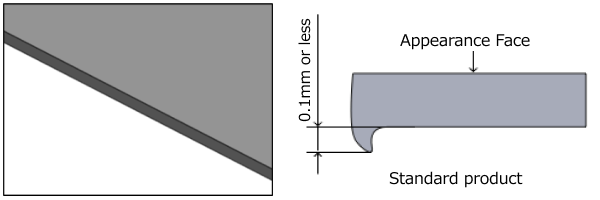
Standard Values for Edge Breaking
| Model Example | Part Example | Standard Value | |
|---|---|---|---|
| Light Edge Breaking |
C/R Edge Breaking
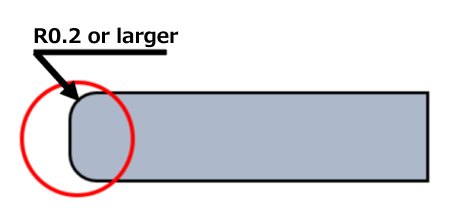
Option Name: “All Around R0.2 or Larger / Corner C1” |
||
![]() |
|
Not Available |
|
|
![]() |
![]() |
|
|
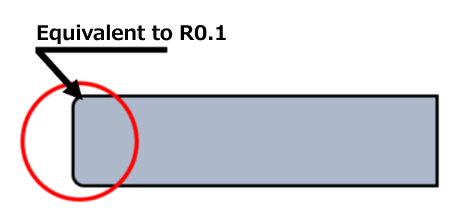
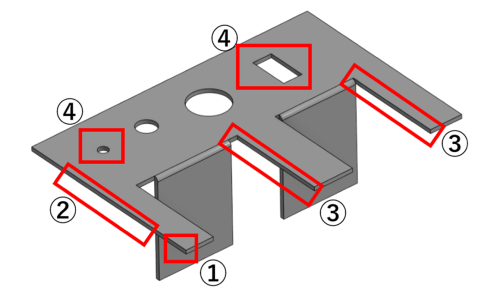
No burrs or flash of 0.1 mm or larger | Finish burrs and flash to approx. R0.1 | |
|
No burrs or flash of 0.1 mm or larger | Finish burrs and flash to approx. R0.1 | |
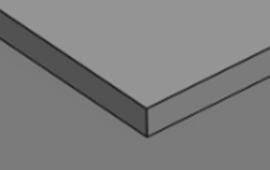
Appearance of Edge Breaking
Finish of light Edge Breaking
- There is a possibility of minor scratches on the appearance because a double-sided deburring machine is used for eliminating burrs.
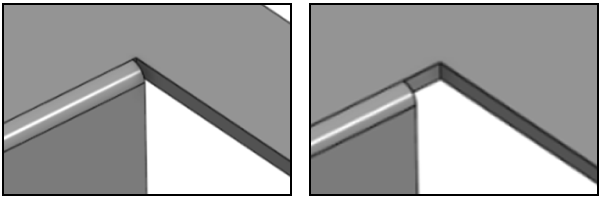
- The contact areas between plates that are not welded tend to be slightly more noticeable compared to parts without edge breaking (see photo on the left below).
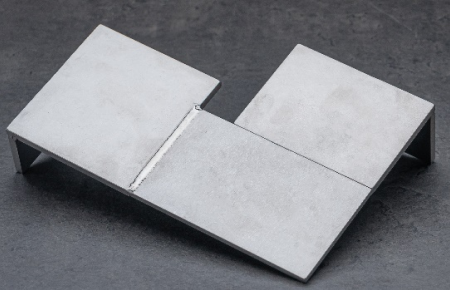
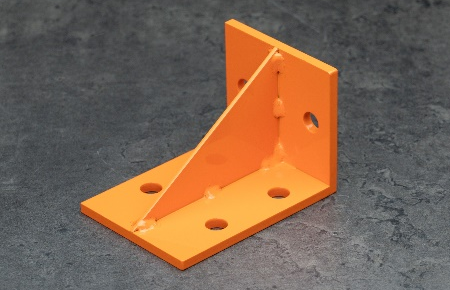
- In addition, areas without weld beads between fillet weld sections may have poor surface treatment adhesion (see photo on the right below).
- Contact areas between plates that are not welded
- Example: EN 1.4301 equiv.(2B), back side welded
- Surface treatment on areas without weld beads between fillet weld sections
- Example: EN 1.0330 equiv.(EN 1.0320 equiv.(hot coiled)), Deep Orange (RAL 2011 equiv., (CMYK 0 50 83 12) 2.5YR6.5/13
Finish of C/R Edge Breaking (All Around R0.2 or Larger / Corner C1)
-
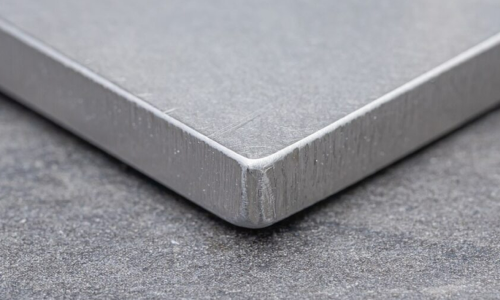
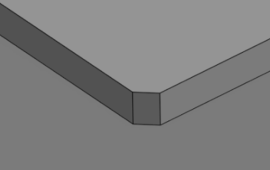
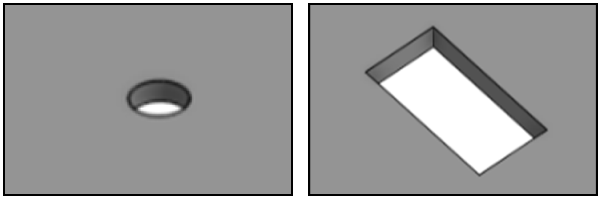
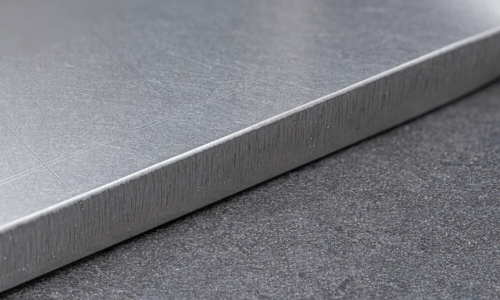
- Edges of sheet metal surfaces are chamfered to R0.2 or larger using a double-sided deburring machine, and product corners are chamfered to C1 by laser processing.
- Fine scratches may occur on the surface during Edge Breaking of edges of sheet metal surfaces.
EN 1.4301 equivalent (2B), thickness 6.0 mm